Clément Lalanne
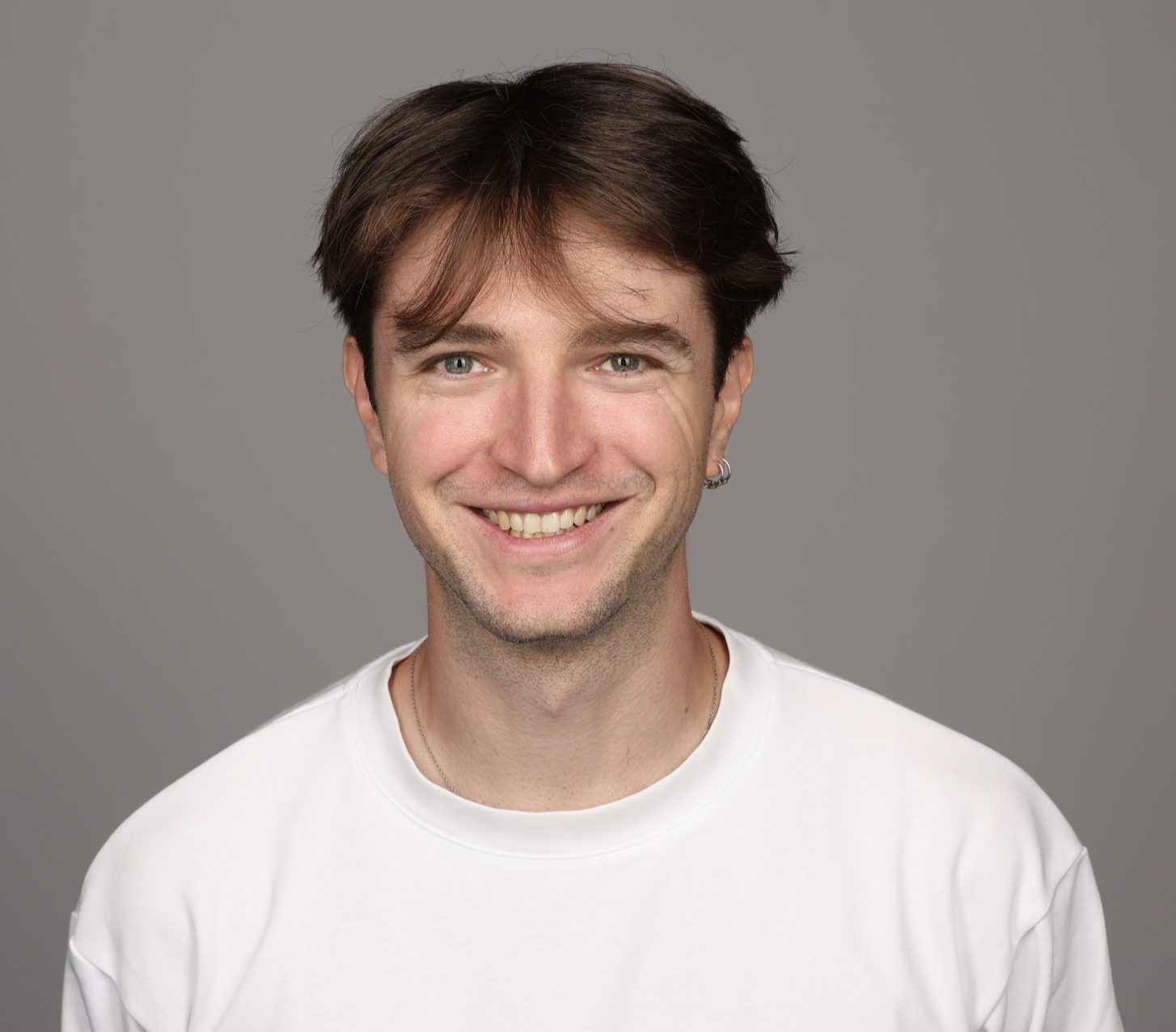
Assistant Professor (MCF) @ University of Toulouse, affiliated with the Institute of Mathematics of Toulouse.
AI co-chair @ ANITI.
My work focuses on Machine Learning, Trustworthy AI, Statistics and Optimization.
Contact:
✉ clement.lalanne@math.univ-toulouse.fr
☎ +33 5 61 55 76 52
Click in the box to add points: a small neural network learns to separate ● from ✕ by gradient descent.
News
- September 2026 Our article Minimax Private Estimation of Smooth Optimal-Transport Maps just got accepted to the 40th Conference on Neural Information Processing Systems (NeurIPS 2026)! Looking forward to presenting our work in Paris. Huge thanks to my coauthors David Rodríguez-Vítores, Franck Iutzeler and Jean-Michel Loubes, and to the reviewers for their useful suggestions.
Try it: private estimation of a one-dimensional transport map from n samples of each distribution.true map T = FY−1 ∘ FX private estimate earlier samplesThe optimal map sends each quantile of the source to the same quantile of the target. Our estimator privately estimates m − 1 quantiles of each sample (median first, then quartiles, …) and matches them, giving the staircase. Its error behaves like max(1/n, 1/(nε)²): privacy is free once ε ≳ 1/√n. More modes change the map but not this rate: in dimension 1, only the bounds on the densities matter.
- September 2026 Our article Measuring Progress in Diffusion Language Model Pretraining just got accepted to the NeurIPS 2026 workshop BeNTo: Beyond Next-Token Prediction — Diffusion & Flow Models for Next-Generation Decoding. The accompanying benchmark, speedrun-dlm, is open source. Huge thanks to my coauthors Antoine Gonon, Adrian Müller, Léon Zheng, Zebang Shen, Ya-Ping Hsieh, Anthony Bardou and Nicolas Boumal!
Try it: how we benchmark diffusion language models on HellaSwag.Colour of a masked word: probability the model gives to the right word, 0 1.A diffusion model has no cheap likelihood, so each ending is masked at a random noise level and the model tries to recover it with the context in view. Its loss (for a masked D3PM, the cross-entropy of the masked words), averaged over a few draws and divided by the ending's length, scores the ending; the lowest score is the model's answer. The model here is a toy: real HellaSwag questions are much harder.Ranking by time to the finish lineReal results from our speedrun: mean HellaSwag accuracy of ten trainings per recipe, along training time on 8 GPUs. A recipe finishes when its accuracy reaches the target and the next measurement confirms it; the fastest wins. Move the finish line to run the first check of our paper: a good target should not reshuffle the ranking when it moves a little. Pairs whose order is still unknown (neither has finished, or one run stopped too early) are left out.
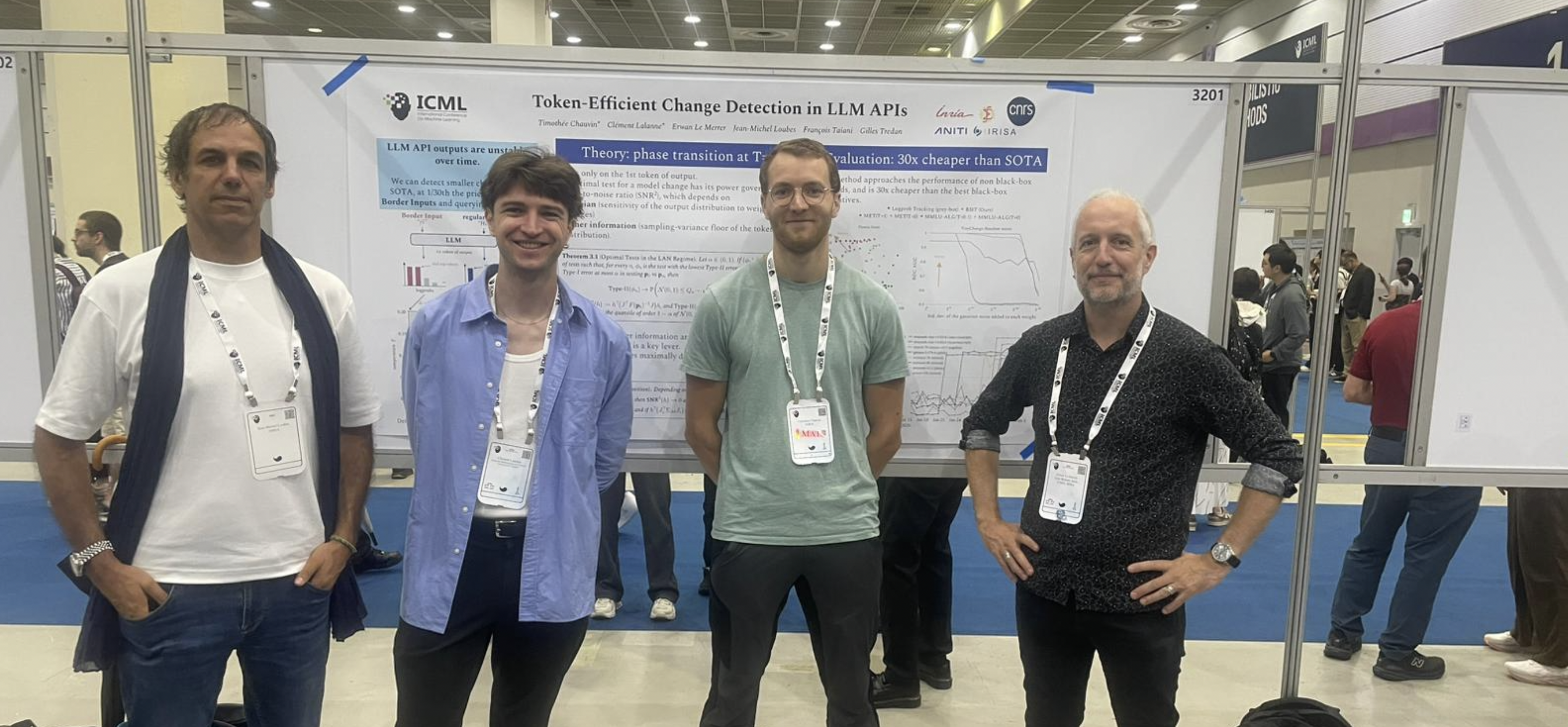
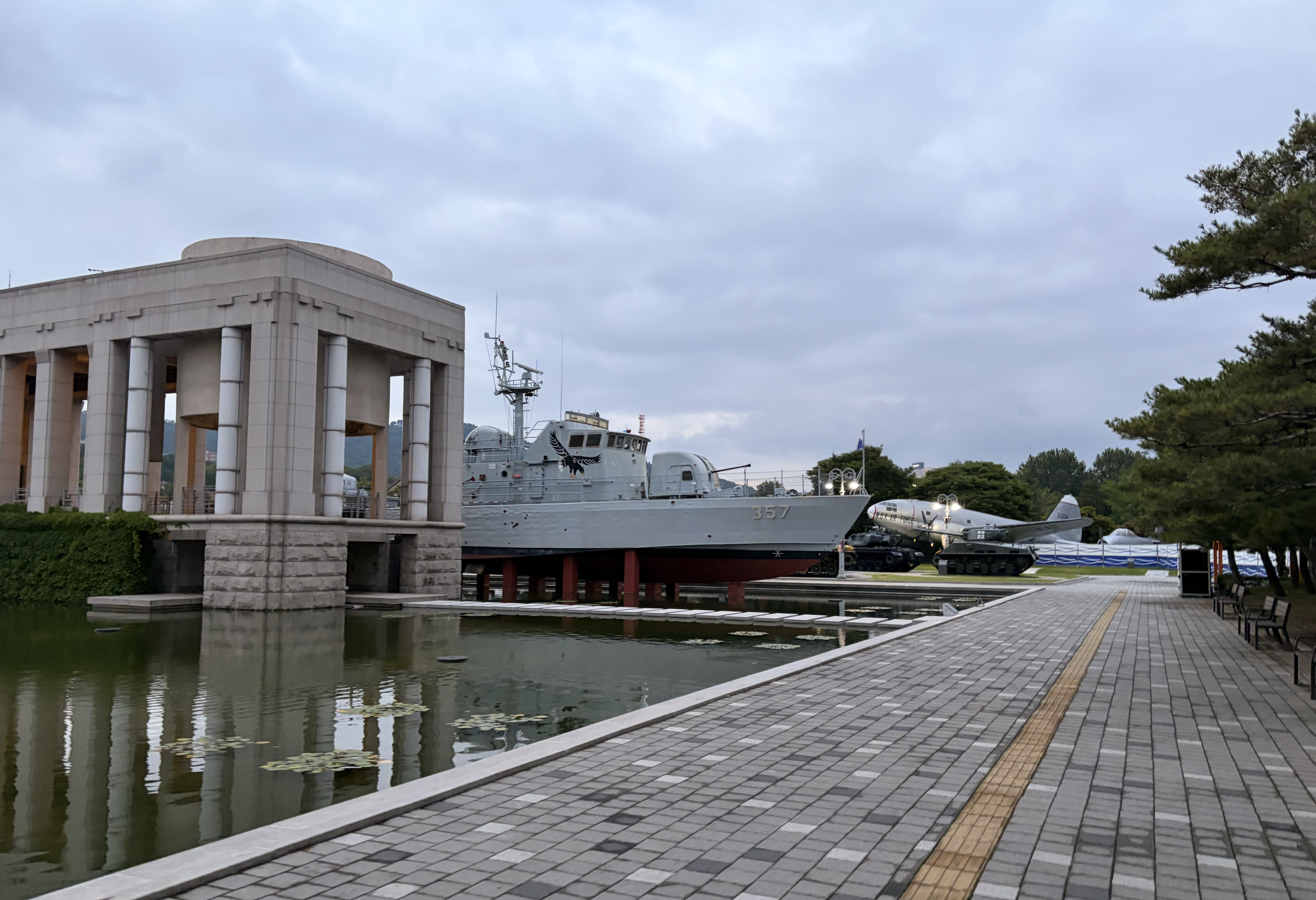
- July 2026 Had a wonderful time at ICML 2026 in Seoul, South Korea, where I presented our article Token-Efficient Change Detection in LLM APIs together with Timothée Chauvin, Erwan Le Merrer and Jean-Michel Loubes (joint work also with François Taïani and Gilles Tredan). It was a stimulating and inspiring week, full of great talks and rich discussions, and it was a real pleasure to reconnect with the community and meet so many brilliant people.
 Try it: a toy LLM completes “The sky is …” with one of three words. Can a small change of the model be detected from a few of its answers?Original modelAfter a small changeDrag the point to choose the model's next-word probabilities (at temperature 1), then lower the temperature. The curves show how each model's probabilities move with the temperature. Each test samples 20 tokens from each model and compares the two histograms (permutation test, level 5%; dashed lines are the expected counts). On a dashed line of the triangle, the two most likely words are tied: on these border inputs, a small change of the model is detected at low temperature. Elsewhere, both models end up always giving the same word and the change goes unnoticed.
 - 📰 News Archive
Publications
This publication list is automatically fetched and formatted from my HAL profile. In case of errors or omissions, please refer to my Google Scholar profile.
Loading publications…
Teaching
- Asymptotic Statistics (M2 RI, University of Toulouse / ISAE-SUPAERO): Course 2026-2027.
- Mathematics of Machine Learning (M2 MAPI3, University of Toulouse): Course 2026-2027, Projects 2026-2027.
- Advanced Statistical Learning (M2 SID, University of Toulouse): Course 2026-2027.
- Mathematical Methods for Supervised Learning (M1 SID, University of Toulouse): Course 2026-2027.
- 📚 Teaching Archive
Curriculum
- 2024-today: Assistant Professor (MCF) in Applied Mathematics at the University of Toulouse and the Institute of Mathematics of Toulouse
- 2023-2024: Postdoc @ Toulouse School of Economics (Toulouse Capitole University) with Jérôme Bolte and Sébastien Gadat
- 2020-2023: PhD in Computer Science @ ENS Lyon under the supervision of
Aurélien Garivier and
Rémi Gribonval, within the Inria OCKHAM team
- 2023: Defended my PhD thesis in computer science, "On the tradeoffs of statistical learning with privacy", on October 4, 2023. You may find the manuscript here and the slides here.
- 2023: Laureate of the Agrégation Externe de Mathématiques
- 2020-2023: Teaching Assistant @ ENS Lyon and Lyon 1. Topics: Machine Learning, Optimization, Data Bases and Data Mining, Competitive Programming, System Programming (see the teaching archive)
- 2016-2020: Undergrad @ ENS Ulm; Civil Servant student (Normalien) in Computer Science (major) and Mathematics (minor)
- 2020: M.S. (Diplôme de l'ENS) in Computer Science with a minor in Mathematics from ENS Ulm
- 2019: M.S. in Applied Mathematics, MVA from ENS Paris-Saclay
- 2019: Internship: Nystagmus waveform extraction using convolutional dictionary learning with detrending, supervised by Nicolas Vayatis, Laurent Oudre and Thomas Moreau, CMLA
- 2018: Internship: Storage-optimal continuous optimization, supervised by Volkan Cevher, LIONS team, EPFL
- 2017: Internship: De-anonymization and privacy: study of a random graph model, supervised by Florian Simatos, DISC, ISAE-SUPAERO
- 2013-2016: CPGE MP* @ Lycée Louis-le-Grand and MPSI/MP @ Lycée Louis Barthou